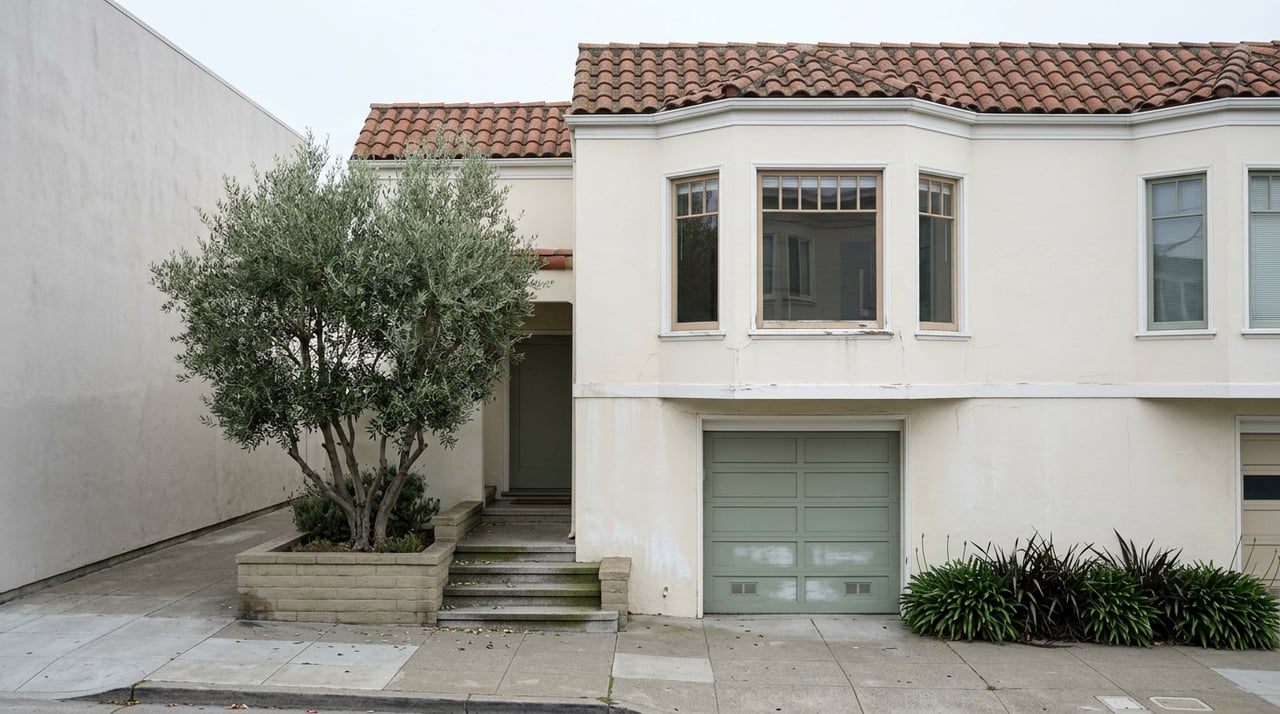
Scroll through active listings in the Marina long enough and you'll eventually hit language you don't see in most neighborhood descriptions: a two-unit building described as sitting "notably outside of liquefaction." Not outside the flood zone, not outside a fault buffer. Outside liquefaction, specifically, as if that were a boundary you could point to on a map and say your building is on the right side of it.
It is. That's the detail most buyers researching the Marina miss, and it's the one that actually matters when you're close to writing an offer.
The neighborhood didn't exist until someone built it
The Marina isn't old San Francisco. Before the early twentieth century, the site was tidal marsh and shallow cove. Rubble from the 1906 earthquake was used to fill it in, creating dry land for the 1915 Panama-Pacific International Exposition. When the fair closed, the city sold the reclaimed ground to developers, who spent the 1920s and early 1930s building the flats, Mediterranean-style homes, and Art Deco buildings that still define the neighborhood today.
That origin story is why the Marina experienced some of the most visible liquefaction damage in San Francisco during the 1989 Loma Prieta earthquake, including fires that spread through the neighborhood after the ground failure ruptured gas lines. It's also why the U.S. Geological Survey and the California Geological Survey have spent decades since mapping, in detailed block-level surveys, exactly which parcels sit on fill susceptible to liquefaction and which don't. Those maps exist because the answer isn't uniform. Some of the young bay-fill deposits liquefy readily under strong shaking. Others, closer to what was originally higher ground before the fill was added, don't carry the same designation at all.
That's the fact the "notably outside of liquefaction" listing is quietly telling you. The Marina's hazard boundary doesn't trace the neighborhood's edges. It cuts through it, sometimes down the middle of a single block.
What the disclosure paperwork actually tells you
According to Custom Home, every California home sale requires two separate documents that matter here, and it's worth knowing the difference before you're staring at a disclosure packet with a deadline attached.
The Transfer Disclosure Statement is the seller's own account of what they know about the property's condition. The Natural Hazard Disclosure report is different: a third-party analysis, tied to the specific parcel, that states plainly whether that address sits inside a mapped Seismic Hazard Zone for liquefaction, an Alquist-Priolo earthquake fault zone, or other state-defined hazard areas.
This is the document that answers the question the neighborhood's reputation can't. It won't tell you what the building next door is rated. It will tell you what your specific address is rated, because the zone was drawn parcel by parcel, not neighborhood by neighborhood.
If you're evaluating a Marina property and you haven't pulled the NHD yet, you're still operating on reputation rather than fact. That's a fine way to get a general sense of the neighborhood. It's not a substitute for knowing your parcel.
The building matters as much as the soil
Soil is only half the risk picture. The other half is the building sitting on it, and that's a separate disclosure question entirely.
San Francisco's Mandatory Soft Story Retrofit Program, established under Ordinance 66-13 in April 2013, targets wood-frame buildings built before 1978 with weak or open ground floors, the kind with parking garages or large storefront openings that can't resist lateral earthquake forces the way the floors above them can, according to the San Francisco Department of Building Inspection. The Marina, along with the Mission, Western Addition, Richmond, Pacific Heights, and North Beach, has one of the city's heavier concentrations of buildings that fall under this program.
According to Seismic Ordinances, retrofit compliance deadlines for most building tiers have already passed, so a qualifying building that still hasn't completed its retrofit isn't simply behind schedule.
The city's Department of Building Inspection maintains a public database of every building subject to this program, searchable by address, showing tier assignment and compliance status. For a multi-unit Marina building, checking that database before you write an offer takes a few minutes and tells you something the listing photos never will.
What the risk actually costs, in dollars
Standard homeowners insurance excludes earthquake damage entirely in California. Coverage requires a separate policy, most commonly through the California Earthquake Authority, and the premium for a San Francisco property runs meaningfully higher than the statewide average, reflecting proximity to the San Andreas fault system. As of mid-2026, San Francisco premiums have generally run in the $2,000 to $5,000 per year range, compared with roughly $1,250 to $2,750 statewide.
The deductible structure is where the real exposure sits. The California Earthquake Authority says its policies offer deductibles from 5 to 25 percent of the dwelling coverage limit. On a Marina condo or flat, where dwelling limits commonly run well into seven figures, the table lists example amounts:
| Deductible | On a $1.5M dwelling limit | On a $2.5M dwelling limit |
|---|---|---|
| 5% | $75,000 | $125,000 |
| 15% | $225,000 | $375,000 |
| 25% | $375,000 | $625,000 |
Every CEA homeowner policy also includes some coverage that doesn't count against that deductible: $10,000 in building code upgrade coverage as a baseline, loss-of-use coverage for temporary housing with no deductible attached, and the first $1,500 of emergency repairs covered outright, according to Express Financial. And a documented soft-story retrofit can lower the premium itself, since CEA offers a Hazard Reduction Discount of up to 25 percent for verified retrofits, according to WalletGrower.
"Our rates are based on the best available science and research, not profit."
That's CEA's own framing for why premiums vary as sharply as they do by address. The science behind that pricing is the same parcel-level data that produces the NHD report. Soil type, foundation, construction era, and proximity to the fault all feed into both.
What the market has and hasn't priced in
None of this has stopped the Marina from being one of San Francisco's more sought-after markets. As of June 2026, the median sale price across the neighborhood was about $2.77 million, down 4.3 percent from a year earlier, a normal give-and-take in a market that remains tightly held rather than a sign that hazard exposure is scaring buyers off. Nobody is discounting Marina listings for sitting on fill. They're pricing the neighborhood the same way they always have and treating the soil question as background noise.
What's less clear is whether that pricing reflects the risk accurately at the individual parcel level. A full-year sample of Marina condo sales, examined years ago against the neighborhood's liquefaction map, found the price gap between units on hazard soil and units outside it was measured in tens of dollars per square foot, not in a discount proportional to the actual difference in insurance cost or rebuild risk. That study is old enough that current pricing may have shifted, but the underlying dynamic it captured, a market that treats "Marina" as one label even though the neighborhood contains genuinely different risk profiles, is structural, not cyclical. It's unlikely to have resolved on its own.
Before you remove contingencies
If you're seriously evaluating a Marina property, three specific checks matter more than general neighborhood research:
- Pull the Natural Hazard Disclosure for the exact parcel, not the neighborhood. Confirm whether that specific address falls inside the mapped liquefaction zone.
- If the building is a qualifying pre-1978 wood-frame structure with five or more units, ask for its soft-story retrofit status and completion date, and check the address against San Francisco's public compliance database.
- Get an actual CEA premium quote for that address before you write an offer. Citywide averages won't tell you what your specific soil and foundation will cost to insure.
A few questions worth asking directly
Does standard homeowners insurance cover any of this? No. Earthquake damage, including liquefaction, is excluded from standard homeowners policies in California without exception. A separate earthquake policy is the only way to cover it.
The Marina's appeal hasn't changed. Flat, walkable streets and direct waterfront access are still scarce in this city, and that scarcity is doing real work in the pricing. What's changed is how much of the risk picture a buyer can actually see before they commit, if they know which documents to pull and which questions to ask about the specific address rather than the neighborhood's name.
If you're looking at a property in the Marina and want a second set of eyes on what its disclosure packet and retrofit history actually say, Patrick Carney can walk through it with you. Let's Connect.
This article is general information, not legal, tax or financial advice. Consult a qualified professional about your situation.
