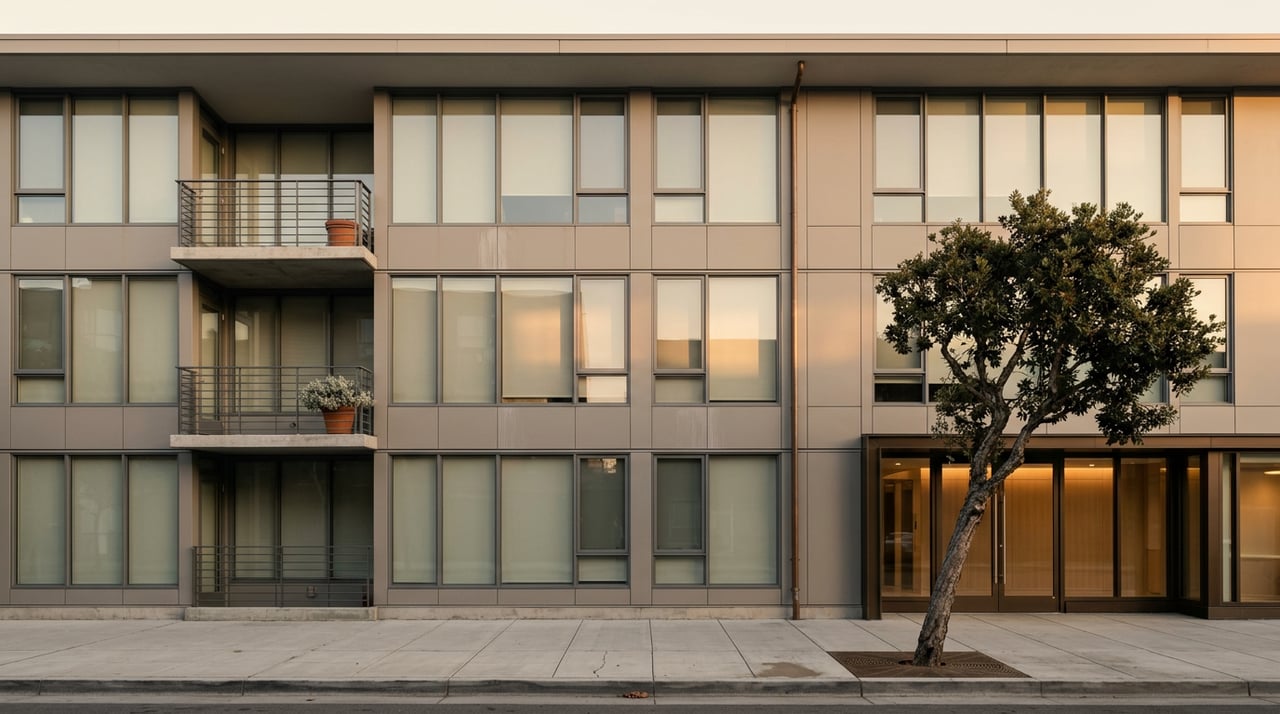
Mission Bay is the San Francisco condo market where the number on the listing tells you the least about what you will actually pay each month. Two units in the same building can carry identical square footage and nearly identical asking prices, and the buyer who wins the one on the north side of Sixteenth Street can end up writing checks that are four to six thousand dollars a year larger than the buyer across the street. The mechanism is public, disclosed, and almost universally overlooked by out-of-neighborhood comparisons.
That gap is the story of this post. The "still below peak" narrative you have read on other sites treats Mission Bay condos as a discount play against South Beach and SoMa. That framing survives a listing-price comparison. It does not survive a true-carry comparison.
The line item that isn't in the listing price
San Francisco's FY 2025-26 secured property tax rate lands at approximately 1.18% of assessed value, with Prop 13 capping the base at 1% and assessed-value growth at 2% yearly. Buyers plug that into a spreadsheet and stop. In most of the city, that is fine. In Mission Bay it is not, because the neighborhood sits inside a Community Facilities District that levies a separate special tax on top of the ad valorem bill.
The district is Community Facilities District No. 6, Mission Bay South Public Improvements. It was authorized under the Mello-Roos Community Facilities Act of 1982 and is administered by the Successor Agency to the former Redevelopment Agency. Its footprint is a specific slice of the neighborhood: roughly 62 taxable acres inside the Mission Bay South Redevelopment Project at buildout. For the current cycle, the district's FY 2025-26 Special Tax Requirement is $12,086,332, and that number is apportioned across the taxable parcels inside the boundary each July.
The city's own guidance confirms the pattern statewide: San Francisco's named districts include CFD 2014-1 in Transbay, CFD 2016-1 on Treasure Island, STD 2020-1 at Mission Rock, and the OCII districts in Mission Bay and Hunters Point Shipyard/Candlestick. Mission Bay is not the only pocket, but it is the largest existing residential CFD in the city by delivered units.
What that adds to a monthly payment
Statewide, typical annual CFD amounts in 2025 and 2026 range from around $360 in smaller or older districts to over $10,000 in larger newer developments, with most buyers in active CFDs paying between $1,200 and $6,000 per year. Translated to a monthly figure, that is roughly $100 to $500 on top of the 1.18% base bill. On the same purchase price, in CFD-heavy ZIP codes, effective property tax rates including all local add-ons can reach 1.5% to 1.7% of the purchase price, compared to the 1.1% to 1.3% typical in non-CFD areas.
The effect on a $1.35 million Mission Bay one-bedroom is straightforward. A buyer running 1.18% comes up with roughly $15,930 in annual property tax. A buyer running 1.55%, which is a plausible all-in number inside CFD No. 6, comes up with roughly $20,925. That is a $5,000 annual gap, or about $415 a month, sitting entirely outside the listing description.
The HOA layer, which is a separate problem
Special tax stacks on a monthly HOA that runs materially above the citywide condo median. Across the Bay Area, HOA dues rose a median of 30% between 2019 and 2024, outpacing inflation at about 22%. San Francisco's increase was 26%, and the city remains one of the most expensive Bay Area jurisdictions for HOA dues at $759 median. That median blends older buildings with newer ones.
Mission Bay's stock skews new. Buildings like One Mission Bay, a 2018 delivery of 350 units at 110 Channel, run in the $800 to $1,000 monthly range for dues that cover doorperson service, exterior maintenance, pool, and management. Buyers comparing that to a $500 flat in Nob Hill are not comparing like properties, but they are also not comparing like carry.
A useful reframe for anyone weighing Mission Bay against South Beach, SoMa, or Rincon Hill: the listing price and the price to own are two different numbers, and the wedge between them is wider here than in almost any other San Francisco condo submarket.
The supplemental bill nobody remembers
There is a third piece, and it is the one that most often catches first-time SF condo buyers. The seller's bill reflects their Prop 13 base capped at 2% growth per year; yours resets to your purchase price at closing. On a long-held home the difference can be large, and it shows up in your first full bill, not years later. The supplemental bill arrives separately from the regular installments, so confirm with your lender whether your escrow account covers it or you are paying it directly.
In Mission Bay this is compounded, because the CFD line is also on the secured bill. Estimating your true first-year tax off the current owner's payment is a mistake anywhere in San Francisco. It is a bigger mistake here.
Running the actual number
Below is what a hypothetical one-bedroom purchase at Mission Bay's Q2 2026 median looks like when the three layers are separated. It is a planning frame, not a quote for a specific unit.
| Line item | Monthly (approx.) |
|---|---|
| Base secured tax at 1.18% on $1.35M | $1,328 |
| CFD No. 6 special tax (mid-range) | $250 to $415 |
| HOA dues (new-construction range) | $800 to $1,000 |
| Carry before principal, interest, insurance | $2,378 to $2,743 |
The reason this matters against the neighboring narrative is timing. Mission Bay's Q2 2026 activity showed the neighborhood's median condo price at $1,350,000, up from $1,168,000 a year earlier. The 15% year-over-year appreciation is real, but the carry math is what determines whether that appreciation clears the buyer's monthly test. A unit that looks cheaper than a comparable Russian Hill condo on price per square foot can end up more expensive to own once CFD No. 6 and a new-construction HOA are added.
Why demand is holding anyway
The reason none of this is stopping activity is the density of institutional expansion inside a ten-minute walk of the residential core. In December 2025, UCSF purchased two neighboring buildings at 499 and 409 Illinois for $767 million, adding 470,000 square feet plus a 600-space parking garage, with the dentistry school moving into the 409 Illinois facility that previously housed FibroGen, Illumina, and the Chan Zuckerberg Biohub. The Bayfront Medical Building at 520 Illinois Street opened in late August and allows UCSF to onboard six new primary-care physicians and schedule approximately 20,000 new appointments a year.
Two civic pieces round out the picture. Construction of Mission Bay School, the neighborhood's first public school, was completed in January 2026 and is scheduled to open in August of the same year. And an EPA-backed ferry landing is scheduled to begin construction in 2026 and is expected to be completed by 2027, adding an all-electric commute option that anchors the eastern edge of the neighborhood. The corporate backdrop is Chase Center, Uber's global headquarters, Visa's headquarters at the Mission Rock development, and OpenAI's offices, all inside the neighborhood boundary.
Demand-side reasons to hold Mission Bay condos in the frame remain intact. That does not change the math on carry.
Pricing the special tax into an offer
Three practical moves for a buyer working this submarket:
- Pull the actual secured bill on the specific parcel before writing. Two units in the same building can carry different CFD apportionments, and the disclosure package will contain the current levy for that unit.
- Ask the listing side whether any portion of the special tax obligation has been prepaid. Most CFDs are structured to last 20 to 40 years, and the tax stays in place until the underlying debt for the infrastructure has been paid off. Remaining term is a real variable.
- Run the offer against the true carry, not the listing carry. If your comfortable payment is $9,000 a month, budget CFD No. 6 and the supplemental bill inside that ceiling before you decide on price.
FAQ
Is CFD No. 6 the same as the Transbay CFD I have read about? No. Transbay is CFD 2014-1 and covers a different footprint of buildings east of the Transbay Transit Center. Mission Bay South is CFD No. 6, administered through the Successor Agency to the former Redevelopment Agency, and it funds park, street, utility, and infrastructure improvements inside the Mission Bay South Redevelopment Project.
Do all Mission Bay condos carry the special tax? No. The taxable footprint at buildout is roughly 62 acres of the 303-acre neighborhood, and the CFD covers Mission Bay South. Parcel-level verification off the county secured tax bill is the only reliable way to confirm.
Does the CFD have an end date? Yes, though it varies by bond series. The Successor Agency refunded a portion of the original bonds through a 2023 issuance. Remaining term is best confirmed through the district's annual administrative report.
How does this compare to an older Nob Hill or Russian Hill condo? Older buildings outside a CFD carry only the 1.18% secured rate plus HOA, and HOA is often lower because amenity load is lighter. The tradeoff is the trade you expect: newer construction, waterfront access, and institutional proximity here versus prewar architecture and lower fixed carry there.
If you are weighing Mission Bay against another San Francisco condo submarket and want the true-carry number on a specific address before you write, Patrick Carney will run the tax line, the HOA line, and the supplemental estimate alongside the comp set. Let's Connect.
